
A method you learn, not a deck you're left with
Most strategy work ends with a document. Someone hands you a polished plan, and the moment the engagement closes, the thinking behind it walks out the door. The next time your world shifts, you're back where you started — calling someone in again.
Level Perspective is built the other way around. We're a specialist practice with one method, and that same method runs through all three stages — Resolve, Anchor, and Mobilize. The first time through, we teach it. By the end, your team can run it.
The plan matters. But the lasting value is your team's ability to make the next plan — and the one after that — without us.
Why this method — and why it isn't ours to own
Before you trust a method with a decision this big, it's fair to ask where it comes from. Here's the honest answer, in three parts: the foundation isn't ours, the tools aren't ours, and the one thing that is ours is the part you can't get anywhere else.
Why Strategyzer
The method isn't a framework we invented. It's the Strategyzer canon — twice winners of the Thinkers50 Strategy Award, used by 200,000+ organizations across 178+ countries.
Open the full reasoning
The method isn't a framework we invented in-house and hope you'll trust. It's the Strategyzer canon — the body of work behind the Business Model Canvas, created by Alex Osterwalder and Yves Pigneur. Their work has twice won the Thinkers50 Strategy Award (in 2015 and 2021), ranked among the world's top management thinkers, and their book is one of the most-cited business books of all time. More than 200,000 organizations across 178+ countries have used these frameworks — including, through Strategyzer's own work, global healthcare names like Bayer, MSD, and Medtronic.
The point isn't the trophies. The point is that you're not betting on one consultant's homemade model. You're standing on the most widely adopted strategy method in the world — proven, taught, and stress-tested across two decades and every kind of organization.
Why a small set of tools
A small set is learnable. The same handful comes back at every stage, so the learning compounds — and because the tools are an open standard, the capability you build is portable.
Open the full reasoning
The method runs on a small, deliberately curated set of visual tools — the same handful, reused at every stage, rather than a new framework for every problem. That's a design choice, and it matters for two reasons.
First, a small set is learnable. Your team can actually hold it in their heads and use it without us in the room. Second — and this is the part that protects you — these tools are an open standard, not a proprietary black box. The capability you build is portable. It belongs to your team. You could keep running these tools with anyone, or with no one but yourselves.
Why these three stages
The foundation is the world's. The tools are the world's. The configuration — Resolve, then Anchor, then Mobilize, tuned for AI decisions in a mission context — is ours.
Open the full reasoning
If the foundation and the tools are the world's, what do you actually get from Level Perspective? The configuration. Strategyzer gives the world a brilliant, general-purpose method. What it doesn't give you is the specific sequence — which tool, in which order, tuned for AI decisions inside a mission-driven healthcare or social-service organization, where success is measured in sustainable, optimal service delivery rather than margin or growth.
That sequence — Resolve, then Anchor, then Mobilize — is our specialist contribution. It's the part you can't get by going to Strategyzer directly, and it's the reason this works for organizations like yours rather than organizations in general.
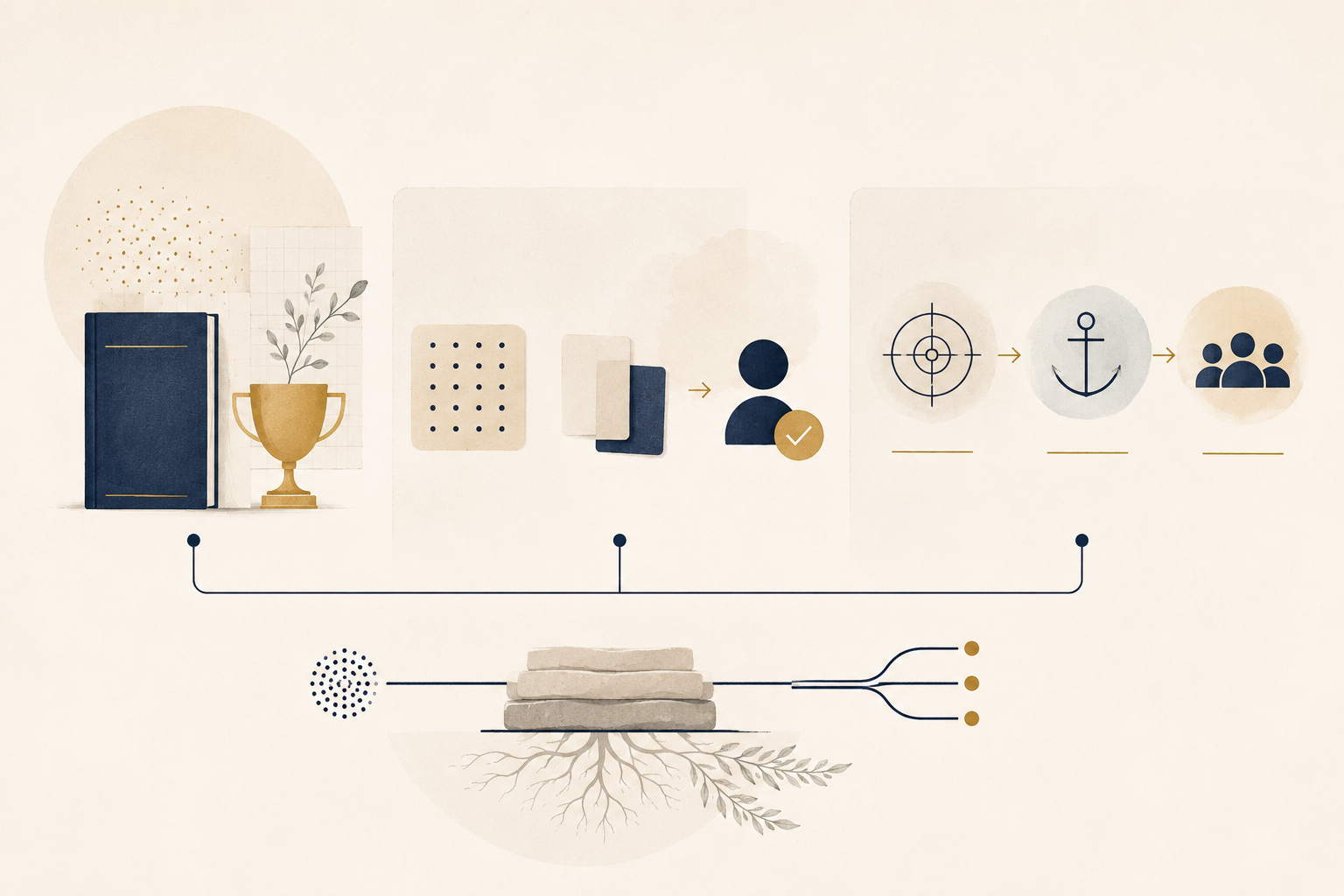
Because the method sits on an open backbone, you're never locked to us. You can have us deliver the work for you, or have us coach your own team to do it — and either way, the capability ends up in-house. A method worth adopting is one you could, in principle, walk away from us and keep using. This one is.
Chris Carlson, who leads every engagement, is a Strategyzer Certified Coach — the direct, personal link between your work and the canon it's built on.
How a week actually runs: learn, then do
The work moves on a steady weekly rhythm. Each week opens with a short, focused session where we teach the tool you're about to use — what it's for, how it works, and what good looks like. Then you do the real work with it, with us alongside.
Heavy teach, light do
The first pass through any tool is heavy on teaching. You're learning the method — and the work alongside it.
Light check, heavy do
Every pass after that leans more on your team and less on us — because you've done it before, and now you're just doing it again on a harder question.
It's a deliberate hand-off. The rhythm is built so that, week by week, the work shifts from us to you.
No surprises: the whole plan is visible before you start
Because the work runs on the Strategyzer platform, there's no mystery about what an engagement is. The full sequence — every step, in order, week by week — is laid out in advance, on the platform, where you can see it before you commit a dollar. The plan of work is the scope. Nothing is hidden, nothing gets discovered halfway through, and the bill can't quietly grow to cover work that was always going to be needed.
That transparency is also why fixed price, scope, and timeline are possible in the first place. We can commit to a number up front precisely because the work is mapped out in advance, not improvised as we go.
Everything lands in one record — and it's yours
Strategy usually scatters: a deck here, a spreadsheet there, a decision someone remembers but can't find. This work consolidates. Every canvas, every decision, and the reasoning behind it land in a single record you own — one source of truth your team keeps and builds on, instead of a document that goes stale by the next quarter.
That record does real work after we're gone. Each stage adds to it rather than starting fresh, so your strategy, your metrics, and the commitments behind them all live in one place your leadership can act on — and that your own AI tools can read, too. When your organization changes, you don't start over. You open the record and re-run the parts that need refreshing.
Built once. Owned for good. Re-run whenever you need it.
Nothing is "validated" until the evidence exists
There's a quiet discipline running through everything we do: we keep a hard line between what you assume and what you've actually proven. Every output carries its grade.
The word "validated" gets used only when there's real evidence to earn it. That sounds modest, and it's actually the opposite — it's what lets a plan survive scrutiny when a board, a funder, or a ministry starts asking hard questions.
We'd rather tell you something is still a hypothesis than let you defend it as a fact and watch it fall apart in the room.
The whole design points one way: your team owning it
Every choice in how this method works is bent toward the same outcome — your team being able to do this without us. The small set of tools, learned once and reused at every stage. The teach-first weekly rhythm. The plan you can see up front. The record you keep. None of it is an accident. It's all built so the capability ends up in-house.
This is also where the small toolkit pays off. Because you meet the same handful of tools in Resolve and use them again in Anchor and Mobilize — each time on a harder question — the learning compounds instead of resetting. (See the tools you'll learn →)
A good engagement leaves you more capable than it found you. That's the test we hold ourselves to.
Strategy as a habit, not a once-a-year scramble
The three stages aren't the end of the story. They feed a continuous operating rhythm — what we call the Strategy Delivery Cycle. Instead of strategy being a heroic, all-hands effort that happens once a year and then gathers dust, it becomes a standard, repeating cycle your team runs. It moves through five plain steps: Monitor what's changing, Diagnose what it means, Plan the response, Execute on it, and Embed the learning back into how you work — then around again.
- Monitorwhat's changing
- Diagnosewhat it means
- Planthe response
- Executeon it
- Embedthe learning
Because you own the record and the tools, each turn of the cycle builds on the last instead of starting from a blank page. Strategy stops being an event you brace for and becomes something your organization simply does — a few times a year, lightly, on a foundation that's already in place. The stages get you to a plan you can run. The cycle is how that plan stays alive.
Most organizations that work with us settle into a light review rhythm — a couple of times a year — to keep the strategy current as funding, demand, and the technology itself keep moving.
The method is easier to see than to describe. Let's talk it through.
A scoping call is 30 minutes — no slide deck, no obligation. We'll talk through where your organization is, how the method would actually run for you, and which stage fits where you are. If it's a good fit, we'll point you to where you'd best begin. If it isn't, we'll tell you that plainly.
Chris Carlson · Founder, Level Perspective · chris.carlson@levelperspective.com